

Tempo: Stripe’s Blockchain for Stablecoin Payments

On September 4, 2025, Stripe and Paradigm have incubated Tempo, a new Layer-1 blockchain purpose-built for payments. Tempo is an independent company (Stripe and Paradigm are first investors) led by Paradigm’s Matt Huang. It targets high-throughput stablecoin transactions (100,000+ TPS with sub-second finality) to meet Stripe’s global payment scale.
Currently in a private testnet, Tempo launched with design input from major partners including Visa, Deutsche Bank, Shopify, Nubank, Revolut, OpenAI, and others. Its mission is to bring real-world payment use cases (payouts, remittances, payroll, etc.) on-chain as stablecoins gain mainstream adoption.
Tempo’s payments-first design:
Predictable low fees
Opt-in privacy
Payments/gas in any stablecoin via enshrined AMM
Payments-first UX (dedicated payments lane, memos, access lists, etc)
Scale (100K+ TPS, sub-second finality)
EVM-compatible, built on Reth
Tempo brings real-world payments onchain, including:
Global payouts, payins, and payroll
Embedded financial accounts
Fast and cheap remittances
Tokenized deposits for 24/7 settlement
Microtransactions
Agentic payments
“As stablecoins go mainstream, there’s a need for optimized infrastructure. Tempo is purpose-built for stablecoins and real-world payments, born from Stripe’s experience in global payments and Paradigm’s expertise in crypto.”


Payments-first technical design
Tempo’s blockchain is EVM-compatible (Solidity support) and built on Paradigm’s high-performance Ethereum client “Reth”. It introduces payments-centric features: predictable low fees, the ability to pay gas fees in any major stablecoin via an enshrined automated market maker, and opt-in privacy to hide sensitive transaction details. A dedicated payments transaction lane, support for memos, and access control lists are planned for better UX in payment flows. Tempo’s consensus will start with a diverse set of invited validators (including some partner companies) and is roadmap’d to transition into a neutral, permissionless Proof-of-Stake network open to all validators.
The platform emphasizes stablecoin neutrality – no native token is required, and users can transact in whichever stablecoin they prefer, with an on-chain AMM ensuring fair conversion for fee payment. Target performance is on par with modern centralized networks (≥100k TPS, sub-1s finality) in order to support microtransactions, real-time payouts, AI-driven “agentic” payments, and other demanding use cases.
Stripe’s crypto strategy and Tempo’s role
Tempo is the capstone of Stripe’s recent crypto push, complementing Bridge and Privy – two crypto infrastructure startups Stripe acquired – to form a full-stack stablecoin solution. Stripe reintroduced crypto payments for US merchants in late 2024, allowing customers to pay online in USDC/USDP on Ethereum, Solana, or Polygon while merchants receive fiat – Stripe takes a 1.5% fee on these stablecoin payments (vs. ~2.9% for cards). It also launched Stablecoin Financial Accounts in 101 countries (May 2025), letting businesses hold stablecoin balances, send/receive funds over both crypto and traditional rails, and convert on-chain payments to local currencies.
These services rely on external networks (Ethereum, Solana, etc.) today; Tempo is intended to integrate with Stripe’s offerings, providing a dedicated, low-cost ledger for stablecoin transactions that Stripe and its merchants can trust. By controlling its own chain, Stripe aims to reduce latency and cost for cross-border payouts and stablecoin card payments, while maintaining compliance (Stripe’s crypto products embed KYC, fraud detection, and conversion to fiat to meet regulatory requirements). Tempo fits into Stripe’s strategy as the on-chain settlement layer beneath Bridge (Stripe’s stablecoin issuance & liquidity API) and Privy (Stripe’s wallet/key management solution), potentially enabling seamless, end-to-end crypto payments within Stripe’s ecosystem.
Bridge & Privy acquisitions – building the “bridge” to Web3
Stripe’s foray into crypto included two major acquisitions. Bridge (a stablecoin infrastructure platform) was acquired in October 2024 for an estimated $1.1 billion (Stripe’s largest acquisition to date) and the deal closed Feb 4, 2025. Bridge provides APIs for issuing and integrating stablecoins (including its own fully-reserved stablecoin USDB) and for orchestrating stablecoin liquidity across multiple blockchains.
By buying Bridge, Stripe gained the ability to offer businesses plug-and-play stablecoin payouts, conversions, and even stablecoin-linked Visa cards (Bridge partnered with Visa in 2025 to let fintechs issue cards that deduct stablecoin and pay merchants in fiat). In June 2025 Stripe announced the acquisition of Privy, a crypto wallet infrastructure startup, for an undisclosed sum. Privy’s SDK allows developers to embed user-friendly wallets into apps without exposing users to seed phrases or off-platform sign-ups.
It uses techniques like key sharding and secure enclaves to manage keys at scale. Privy will continue to operate as an independent product under Stripe, providing “secure wallet infrastructure” for Stripe’s crypto offerings. Together, Bridge + Privy + Tempo form a vertically-integrated loop: Bridge handles stablecoin liquidity and compliance (including custody of reserves and KYC/AML checks), Privy handles wallet creation and key management for end-users, and Tempo will process the on-chain transactions.
This stack abstracts away blockchain complexity for developers – e.g. a fintech using Stripe can onboard users with Privy wallets, move funds on Tempo in USDC or USDB via Bridge, and never worry about gas tokens or custody logistics. (Notably, “Bridge” in this context refers to Stripe’s stablecoin platform, not a cross-chain bridge – it’s about bridging crypto and fiat finance.) The security model leverages Stripe’s trusted custody for fiat/stablecoin conversion and a forthcoming decentralized validator set for the Tempo chain, while giving developers flexibility between custodial and non-custodial wallets. Industry speculation: Stripe has not announced any native Tempo token – the platform likely uses stablecoins for fees – but it’s possible Stripe and Paradigm will hold equity or other rights in Tempo as it evolves. If no token is issued, Tempo’s economic model may resemble a public utility chain, with Stripe monetizing via on/off-ramp services (Bridge fees, etc.) rather than via the protocol directly.

Paradigm’s role and significance
Crypto VC Paradigm is not only co-funding Tempo but also providing leadership and technical backbone. Paradigm’s co-founder Matt Huang serves as Tempo’s CEO, while still leading Paradigm itself. Paradigm brings deep crypto expertise – the firm has incubated or contributed to several foundational crypto projects (e.g. it was first outside investor in Uniswap, supported Optimism’s rollup development, and backed Flashbots for MEV mitigation). Paradigm also builds open-source tools like Foundry (Ethereum dev toolkit) and Reth (a Rust-based Ethereum client); notably, Reth is the execution engine powering Tempo. Paradigm’s involvement lends technical credibility and signals that Tempo aims to be developer-friendly and neutral infrastructure (Paradigm emphasizes “advancing the crypto frontier” as both investor and builder). In terms of resources,
Paradigm is one of the largest crypto-focused VCs: it raised a $2.5 billion fund in 2021 (then the industry’s largest) and an $850 million fund in mid-2024 focused on early-stage crypto projects. While Paradigm’s total assets under management are not disclosed, public filings suggest it manages on the order of $3+ billion dedicated to crypto venture. Paradigm’s sector focus remains squarely on crypto/Web3 (despite a temporary broadening to “frontier tech” in 2023), and it has a track record of influencing crypto governance and technical direction through research (e.g. Paradigm researchers have shaped debates on protocol design, MEV, etc.).
For Tempo, Paradigm’s backing likely means an emphasis on decentralization over time – Huang has stated they are “building Tempo with principles of decentralization and neutrality” and plan to launch with a diverse set of validators and then “transition to a permissionless model”. Paradigm’s collaboration with Stripe here also illustrates the increasing convergence of traditional fintech and crypto expertise: Paradigm ensures the blockchain meets crypto community standards, while Stripe ensures it serves enterprise payment needs.
Competitive Landscape
Tempo enters an increasingly crowded arena of payment-oriented blockchains and scaling solutions. Unlike general-purpose Layer-1s (Ethereum, etc.) or DeFi-centric Layer-2s, Tempo is pitched as “payments-first”. Its closest comparables are other high-throughput, stablecoin-focused networks emerging to tackle cross-border and micropayments. For instance, Tron – though originally an Ethereum alternative – today functions as a de facto stablecoin rail (carrying tens of billions in USDT transfers) with negligible fees and ~3 second block times, albeit through a centralized 27-super-representative consensus. Solana, a high-performance L1, offers sub-second finality and sub-cent fees; it has recently been used by Visa for pilot stablecoin settlements (Visa is one of the first major institutions to use Solana for USDC payments, improving cross-border settlement speed).
Another competitor is the Fireblocks Network, launched in Sept 2025, which connects institutions for stablecoin payments (backed by Circle and others) as a kind of “stablecoin SWIFT” for enterprises. Even big tech is joining the fray: Google is developing a “Universal Ledger” L1 for financial assets (taking a different approach with Python smart contracts and targeting institutional use), and Circle (USDC’s issuer) is reportedly exploring its own blockchain or consortium network for stablecoin settlement
Adoption indicators to watch
As of September 2025, Tempo is in private testnet with no public usage data. However, design partner traction is a key early signal, and Stripe and Paradigm have assembled an unusually high-profile group of partners across tech (e.g., Anthropic, OpenAI for AI-driven payments), e-commerce (Shopify, DoorDash), fintech (Revolut, Nubank, Mercury), and banking (Deutsche Bank, Standard Chartered, Lead Bank). Many of these partners likely have pilot projects in the works: for example, an e-commerce player might trial accepting stablecoins via Tempo to reduce card fees, or a bank might explore issuing tokenized deposits on Tempo for 24/7 interbank settlement. Developer interest beyond the founding team (reported ~15 people) will become clearer if or when Tempo opens a public testnet or documentation. Being EVM-compatible lowers the barrier for Web3 developers, and Paradigm’s tooling (Foundry, etc.) can attract Solidity engineers, but success will depend on whether Tempo delivers the promised performance in practice.
Early network metrics to watch in testnet or mainnet will be TPS under load, transaction finality times, and cost per transaction (to confirm “predictable low fees” even at scale). On the enterprise side, any public pilot or integration announcement will be significant validation, for example if Stripe itself routes a portion of its stablecoin payout volume through Tempo, or if a partner like Visa or Shopify goes on record about Tempo usage. Stripe’s May 2025 launch of stablecoin accounts provides a base of 100k+ businesses using stablecoins via Stripe; conversion of even a slice of that volume to Tempo (from Ethereum or Tron) would indicate real traction. We will also monitor ecosystem development: Tempo might establish an ecosystem fund or grants (Paradigm often supports hackathons or grants for its projects) to spur third-party apps on the chain, and any announced grant program or third-party developer tooling would signal momentum. In terms of compliance footprint, Stripe’s involvement means Tempo is likely being built with regulatory expectations in mind (e.g., Travel Rule compliance for large transfers, integration with Stripe’s identity verification for on and off ramps). If national regulations (like a potential U.S. stablecoin bill) impose standards on stablecoin networks, Tempo’s adoption by banks and big fintechs may hinge on proving strong KYC or AML controls at the application layer.
The presence of regulated entities as validators during Tempo’s early phase suggests compliance will be factored into governance (e.g., blacklisting illicit addresses, adhering to sanctions, an open question for a “neutral” chain). So far, there is no indication of any special permissioning for users or assets on Tempo (it is described as permissionless neutral infrastructure), meaning compliance would be handled by Stripe and partners interfacing with the chain, not by the chain protocol itself. How this balance is struck will influence comfort levels for enterprise and institutional users.
Stripe - Timeline of Key Announcements
Jan 23, 2018: Stripe ends its first crypto support (Bitcoin payments), citing slow transaction times and user lack of interest (ending a 4-year experiment since 2014).
Oct 10, 2024: Stripe relaunches crypto payments for merchants in the U.S., enabling checkout in stablecoins. Customers can pay in USDC or USDP on Ethereum, Solana, or Polygon; Stripe instantly converts to USD for the merchant. Stripe sets a 1.5% fee, undercutting card rates. In the first 24 hours, buyers from 70+ countries used the option, though adoption remained niche.
Oct 2024: Stripe agrees to acquire Bridge (Bridge.xyz), a Texas-based stablecoin infrastructure startup. Media report a $1.1 B price, making it one of crypto’s largest M&A deals. Bridge’s platform had helped fintechs issue and manage stablecoins; Stripe’s interest signaled its commitment to stablecoins as “the killer app” for global money movement.
Feb 4, 2025: Stripe officially closes the Bridge acquisition. Stripe Crypto’s business lead highlights that “stablecoins will play a critical role in turbocharging cross-border commerce,” underlining why Stripe bought Bridge. (At about $1.1B, Bridge is Stripe’s largest acquisition to date, exceeding even major prior deals in fintech.)
May 7, 2025: At “Stripe Sessions 2025” conference, Stripe announces Stablecoin Financial Accounts in 101 countries. Businesses can now hold stablecoin balances (initially USDC and Stripe’s own USDB) and send or receive funds via traditional banking rails or eight crypto blockchains from the Stripe Dashboard. Stripe pitches this as an answer for businesses in inflationary economies to access USD-based finance. Stripe also reveals a Visa partnership via Bridge: fintechs can issue Visa cards linked to stablecoin wallets so users spend stablecoin balances online or in store, with Bridge handling FX conversion in the background.
June 11, 2025: Stripe announces agreement to acquire Privy, a crypto wallet infrastructure provider powering 75+ million accounts for Web3 apps. Privy will remain an “independent product” under Stripe’s umbrella. The deal (terms undisclosed) is Stripe’s second major crypto acquisition in under a year, following Bridge. It equips Stripe with in-house wallet tech to streamline crypto user onboarding (Privy’s API enables one-click wallet creation and login for end users).
Aug 2025: Tempo leaks. Fortune reports that Stripe is incubating a new blockchain project, codenamed “Tempo,” after a Stripe job posting seeking blockchain engineers is spotted. Initial sources claim a stealth team of about 5 to 15 people is building a Layer 1 focused on payments, not a Layer 2 or sidechain. Stripe and Paradigm decline to comment publicly at this time.
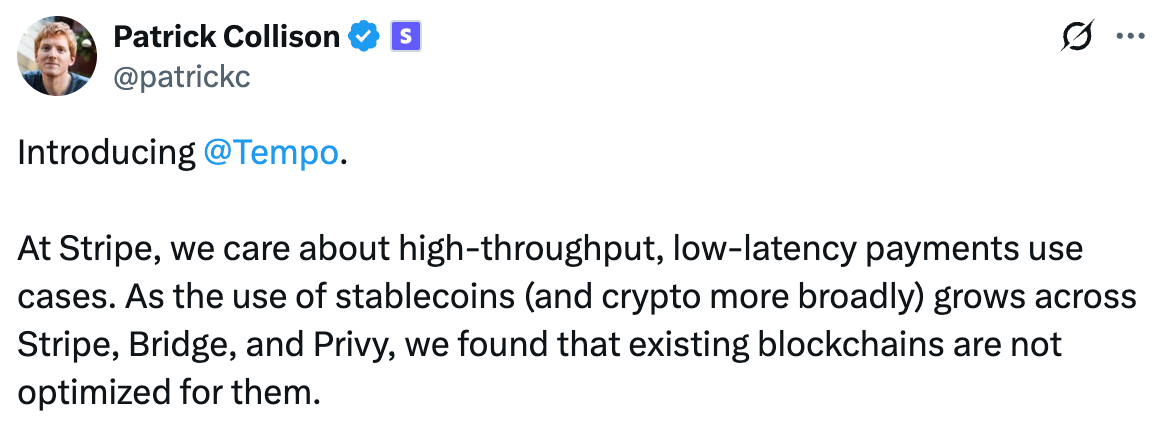
Sept 4, 2025: Tempo is officially unveiled. Stripe CEO Patrick Collison announces Tempo on X (Twitter), saying existing blockchains do not meet Stripe’s needs for “high-throughput, low-latency payments use cases” as stablecoin usage grows across Stripe’s products. Paradigm’s Matt Huang publishes a blog post introducing Tempo as a “payments-first blockchain” born from Stripe’s global payments experience and Paradigm’s crypto expertise. It is confirmed that Tempo is a new independent company jointly incubated by Stripe and Paradigm, in private testnet with select partners. The announcement lists prominent design partners (Visa, Shopify, Deutsche Bank, OpenAI, etc.) and highlights features like stablecoin gas fees, 100k TPS target, and plans for decentralization. That same day, a crypto infrastructure firm coincidentally launches its own Stablecoin Payments Network with support from Circle and others, underscoring the competitive push in this space.
Stripe’s crypto stack with Tempo
Imagine Stripe’s platform as a layered stack: at the top are Stripe’s merchants and end-users, transacting via familiar web/mobile interfaces or Stripe APIs. Under the hood, when a user makes a payment or a business moves funds, Stripe can now leverage its crypto stack:
Privy (Wallet Layer)
This is the user-facing wallet infrastructure (a Stripe-owned service after 2025). If an end-user opts to pay with crypto or a business wants to hold stablecoins, Privy seamlessly creates or accesses a non-custodial wallet for them. The user doesn’t see seed phrases; they might log in with email or OAuth, and Privy manages keys behind the scenes (using secure enclaves and sharding). In an architecture diagram, Privy would sit at the edge of the network, interfacing with apps and holding encrypted keys that control on-chain addresses. It provides the bridge between Web2 identity and Web3 wallets – linking a Stripe account or email to an on-chain account.
Bridge (Stablecoin Banking Layer)
Below Privy, Stripe’s Bridge service acts as the treasury and liquidity engine. Bridge connects to both traditional financial rails (ACH, SWIFT, card networks) and crypto rails. In a diagram, Bridge would be a central hub that can issue and redeem stablecoins. For example, when a Stripe merchant converts $10,000 to stablecoins, Bridge either mints Stripe’s own USDB or sources USDC/USDT liquidity, and allocates it to the user’s on-chain wallet (managed via Privy). Conversely, when someone receives stablecoin and wants fiat, Bridge handles burning the stablecoin and initiating an ACH/wire payout. Bridge also routes transactions: if a payment needs to go from a user’s wallet to a merchant’s bank account in another country, Bridge will handle the stablecoin transfer and the conversion to the target currency. Architecturally, Bridge interfaces upward with Stripe’s core ledger (to record balances, compliance info) and downward with blockchains – including Tempo and others. It enforces compliance by embedding KYC/AML checks (e.g. requiring businesses to be verified before enabling crypto) and by integrating with blockchain analytics to monitor transactions. In essence, Bridge is the custody and conversion layer, ensuring that every stablecoin on-chain is backed by real reserves and that money can seamlessly hop between on-chain and off-chain systems.
Tempo (Blockchain Ledger Layer)
At the base is the Tempo blockchain network itself – this is the distributed ledger where transactions get recorded. In a diagram, Tempo would be depicted as a network of validator nodes (operated by various partners and eventually the community). Tempo receives transaction instructions from Bridge (e.g. “transfer 100 USDC from Alice’s wallet to Bob’s wallet”) and orders/executes them on-chain. Since Tempo is EVM-compatible, it can also run smart contracts – for instance, Bridge’s enshrined AMM might be a smart contract on Tempo that automatically swaps one stablecoin for another to facilitate gas payments temposite.
The opt-in privacy feature could be visualized as a special module or sidecar service connected to Tempo nodes, where users can invoke cryptographic functions (like zero-knowledge proofs) to obscure certain transaction details (perhaps akin to how optional shielded transactions work on some chains). Tempo’s payments-specific enhancements – like a dedicated mempool or “fast lane” for payments – would be drawn as part of the blockchain’s core, optimizing how transactions propagate and finalize (e.g. maybe separating large fund transfers from microtransactions to avoid congestion). Importantly, Tempo is chain-agnostic to stablecoins: USDC, USDT, USDB, etc., all exist as tokens on Tempo, and the enshrined AMM plus native support means a user holding USDC can pay fees without ever touching another token industrynews.
In a system diagram, one might annotate that “gas = stablecoin (via AMM)” on the Tempo layer, highlighting this differentiator versus Ethereum where gas is ETH. Finally, Tempo connects to external blockchains and systems via Bridge: if value needs to move off Tempo (say to Ethereum or Solana because a recipient prefers those), Bridge can facilitate that by coordinating burns on Tempo and re-minting on the target chain (or using liquidity pools).
Architecture can be described as a closed-loop Stripe Crypto Stack
Privy (user wallets) → Bridge (stablecoin banking and compliance) → Tempo (transaction ledger). Surrounding this loop, Stripe’s traditional infrastructure (merchant dashboard, checkout APIs, fraud prevention via Radar, etc.) remains in place, treating crypto transactions almost interchangeably with card or bank transactions.
Stripe’s role is orchestrator: its systems decide whether to send a payment through card networks, ACH, or Tempo+Bridge based on cost and speed. Meanwhile, the end-user and merchant experience a unified Stripe interface (they might barely realize a blockchain was involved, except perhaps seeing “via stablecoin” on a receipt). This design aims to combine the trust and ease of Stripe’s platform with the efficiency of crypto rails, using Tempo as the custom-built highway for value if one imagines the analogy of a transportation network.
Tempo
partners@tempo.xyz
Sources
Risk Disclaimer:
insights4.vc and its newsletter provide research and information for educational purposes only and should not be taken as any form of professional advice. We do not advocate for any investment actions, including buying, selling, or holding digital assets.
The content reflects only the writer's views and not financial advice. Please conduct your own due diligence before engaging with cryptocurrencies, DeFi, NFTs, Web 3 or related technologies, as they carry high risks and values can fluctuate significantly.
Note: This research paper is not sponsored by any of the mentioned companies.
great breakdown
thanks